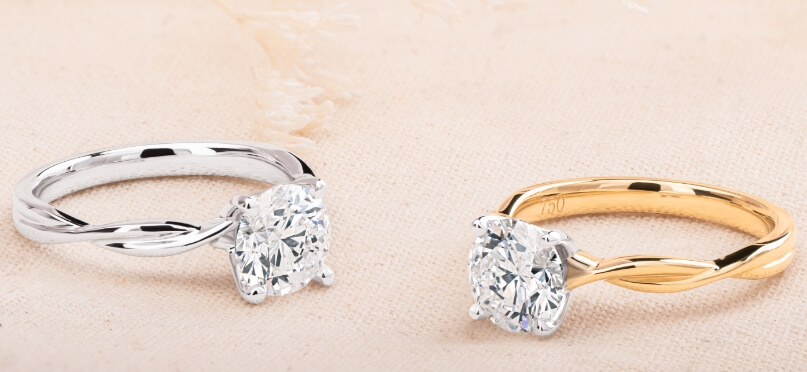

Buying a diamond involves more than choosing a stone that looks attractive under jewelry store lighting. Two diamonds of similar size can differ significantly in brilliance, appearance, and price. These differences often come down to four measurable characteristics.
A diamond 4c chart helps buyers compare cut, color, clarity, and carat weight using established grading standards. Developed by the Gemological Institute of America (GIA), the Four Cs provide a common language for evaluating diamond quality. Knowing what each grade means makes comparing stones easier and helps prevent unnecessary spending.
Cut: The Quality Behind a Diamond’s Sparkle
Cut describes how well a diamond’s proportions, symmetry, and polish work together to reflect light. It shouldn’t be confused with shape, which refers to outlines such as round, oval, or pear.
A well-cut diamond returns light toward the viewer, producing brightness, colorful flashes, and sparkle. Poor proportions can allow light to escape, leaving the stone looking dull despite excellent color or clarity.
For standard round brilliant diamonds, GIA uses five cut grades:
- Excellent
- Very Good
- Good
- Fair
- Poor
An Excellent cut often provides impressive light performance, although diamonds within the same grade can still look different. Buyers should examine stones under several lighting conditions rather than relying entirely on a grading report.
Cut quality deserves particular attention because a slightly smaller, well-cut diamond may appear livelier than a larger stone with weaker proportions.
Color: Small Differences That Affect Price
Diamond color grading measures the absence of color in diamonds within the normal D-to-Z color range. The GIA scale begins at D, representing colorless stones, and ends at Z, where light yellow or brown coloration becomes noticeable.
The scale separates diamonds into several categories:
| Grade | Color classification |
|---|---|
| D–F | Colorless |
| G–J | Near Colorless |
| K–M | Faint |
| N–R | Very Light |
| S–Z | Light |
Color differences between neighboring grades can be difficult to detect without controlled lighting and comparison stones.
For many buyers, G through J diamonds offer an appealing balance between appearance and price. Metal choice also influences perception. Yellow gold settings can complement warmer diamonds, while white gold or platinum may make subtle warmth more noticeable.
Fancy-colored diamonds follow a separate grading system, so this scale doesn’t apply to vivid pink, blue, or other fancy colors.
Clarity: Looking Beyond Natural Imperfections
Most natural diamonds contain internal characteristics called inclusions or external features known as blemishes. Clarity grading evaluates their size, number, position, nature, and visibility under 10-times magnification.
The GIA clarity scale includes 11 grades, ranging from Flawless (FL) to Included (I1, I2, and I3).
A diamond with a VS1 or VS2 grade often has inclusions that are difficult to notice without magnification. Some SI1 diamonds also appear clean to the naked eye, although this depends on their individual characteristics.
Location matters as much as the grade. A dark inclusion beneath the table, the diamond’s large top facet, may be more noticeable than a similar inclusion near the edge.
Buyers should inspect magnified images and normal viewing photographs before deciding whether a higher clarity grade justifies its price.
Carat Weight: Size Without the Guesswork
Carat measures weight rather than visible dimensions. One carat equals 200 milligrams, and each carat contains 100 points.
A diamond weighing 0.90 carats may look remarkably similar in size to a one-carat diamond, particularly when both have comparable proportions. However, prices can rise noticeably at popular weight milestones.
Face-up appearance also depends on shape and cutting proportions. An elongated oval may appear larger than a round diamond of equal weight because its surface spreads across a different outline.
Checking millimeter measurements alongside carat weight gives buyers a more accurate sense of visible size.
Reading the Four Cs Together
A diamond 4c chart becomes most useful when comparing several characteristics rather than treating each grade independently.
Consider two one-carat round diamonds. One has D color, VVS1 clarity, and Good cut. The other has H color, VS2 clarity, and Excellent cut. The second may offer stronger sparkle and better visual value despite its lower color and clarity grades.
The same evaluation principles apply to lab diamonds, which have essentially the same chemical composition and optical properties as natural diamonds. Their origin differs, but cut quality and visible characteristics still deserve careful attention.
Check the Grading Report
Before purchasing, review an independent grading report from a recognized laboratory. Confirm the measurements, proportions, clarity characteristics, and any reported treatments.
For round brilliant diamonds, pay particular attention to cut grade. For fancy shapes, photographs, videos, and direct inspection become especially valuable because grading approaches differ.
Choosing a Diamond That Fits Your Priorities
The most expensive grades aren’t necessary for an attractive piece of jewelry. A balanced combination of strong cutting, pleasing color, and visually acceptable clarity often delivers better value than chasing perfect specifications.
A diamond 4c chart provides a reliable starting point, but personal observation should guide the final choice. This remains true for natural stones and lab diamonds alike. Compare diamonds within your budget, examine their actual appearance, and prioritize the qualities you’ll appreciate every time you wear the jewelry.